Highly-vetted marketplace connecting publishers and advertisers

State of Guest Posting 2026: Data from 800+ Publishers and the SEO Industry

Guest posting has been declared dead at least a dozen times. It keeps not being dead.
In 2026, guest posting is still the most popular link building tactic, ahead of broken link building, digital PR, resource page outreach, and other methods. The market has changed, prices have shifted, and Google’s algorithm is tougher on low-quality placements. Still, demand for editorial backlinks on real websites is stronger than ever.
This report brings together first-party data from the Adbassador marketplace, which includes 804 live publisher listings, along with research from Ahrefs, Backlinko, BuzzStream, and the Authority Hacker link building survey. The aim is to provide a single reference that shows what the guest posting market looks like in 2026: costs, placement distribution, how buyers earn links, and what research says about its effectiveness.
How to Cite This Report
Canonical URL: https://adbassador.com/state-of-guest-posting-2026/
Published: April 15, 2026
Publisher: Adbassador
APA-style citation:
Adbassador. (2026, April 15). State of Guest Posting 2026: Data from 800+ publishers and the SEO industry. https://adbassador.com/state-of-guest-posting-2026/
Short citation:
Adbassador, State of Guest Posting 2026.
All first-party statistics in this report are drawn from live Adbassador marketplace inventory as of April 15, 2026. Tables and charts may be reproduced with attribution and a link to the canonical URL.
Key Findings
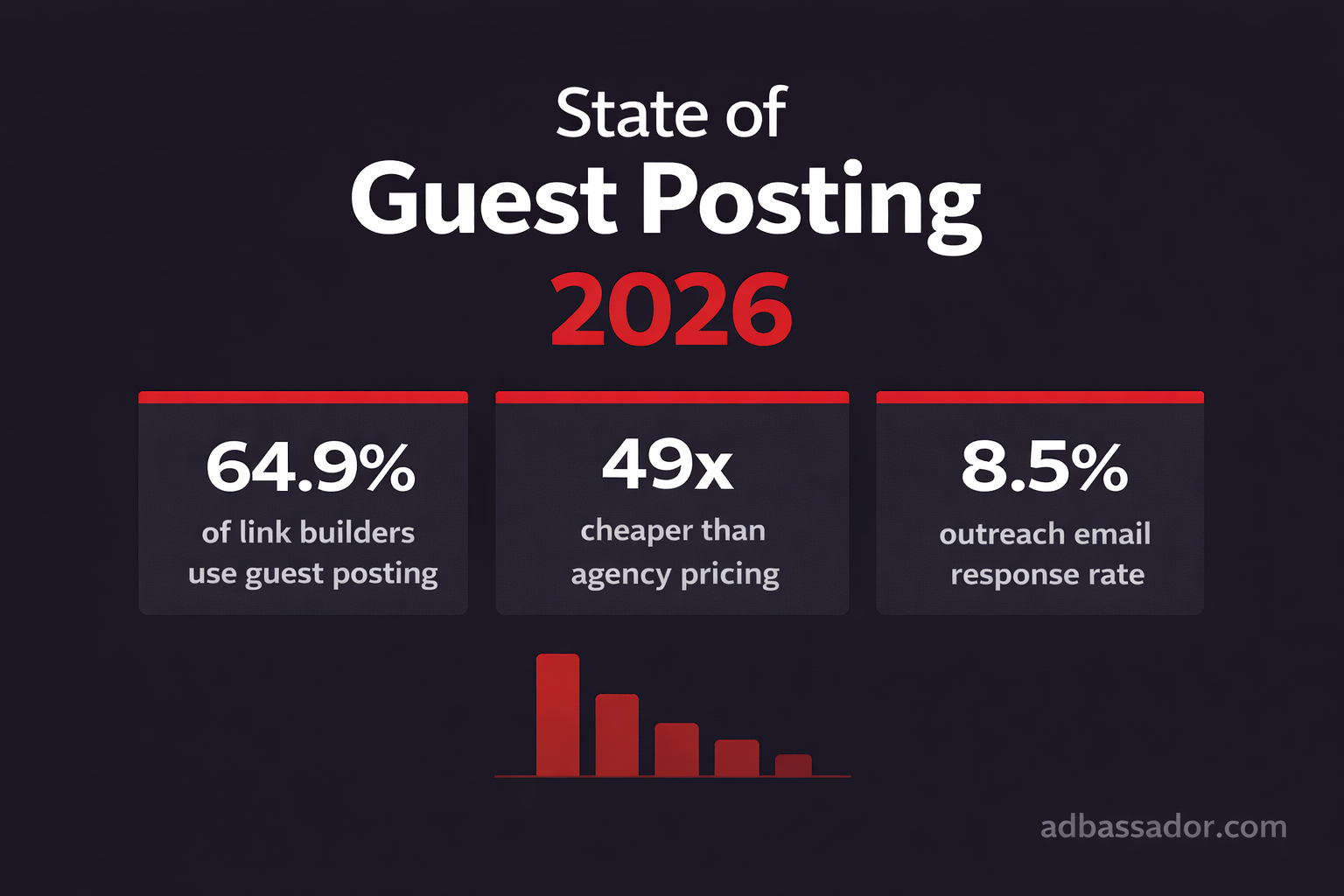
- 64.9% of link builders use guest posting – making it the single most popular link building tactic, ahead of every alternative method (Authority Hacker / DemandSage, n=755)
- The median guest post on Adbassador costs $30, average $86 (Adbassador first-party, n=656 guest post listings)
- Agencies charge an average of $1,459 for the same placement – roughly 49x the marketplace median (BuzzStream analysis of 26,632 sites)
- 53% of live Adbassador listings are priced between $25 and $50, representing the practical working range for most campaigns (Adbassador first-party, n=804 listings)
- Only 8.5% of cold outreach emails receive a reply – it takes an average of 146 emails to earn a single backlink through manual outreach (Backlinko, n=12M emails; Authority Hacker, n=600K+ emails)
- The #1 result in Google has 3.8x more backlinks than positions #2 through #10, and Google’s own internal documents confirm links remain a core ranking signal (Backlinko, n=11.8M SERPs; Ahrefs, n=1M SERPs; DOJ trial exhibits, 2024)
- Less than 5% of guest post sites meet basic quality thresholds (DR 71+ and 50K+ monthly organic traffic), which is why vetting matters more than volume (BuzzStream, n=26,632 sites)
- Guest posts make up 81.6% of Adbassador marketplace inventory, with link insertions (10.9%), press releases (6.1%), and banner ads (2.4%) making up the rest (Adbassador first-party, n=804 listings)
1. How Popular Is Guest Posting?
Guest posting dominates the link building mix. According to a survey of 755 link builders conducted by Authority Hacker and cited by DemandSage, 64.9% use guest posting as a primary tactic. No other method comes close.
The same survey found that 79.7% of SEOs consider link building an important part of their overall strategy. So the question most teams are wrestling with isn’t whether to build links – it’s how to do it without paying agency rates or burning hours on outreach that mostly goes unanswered.
That last part is a real issue. Backlinko’s analysis of 12 million outreach emails found that only 8.5% get any response at all. Authority Hacker found it takes an average of 146 emails to earn a single backlink through manual outreach. At typical agency rates of $100 to $150 per hour, that’s $500 to $1,500 in labor for one link before any placement fee.
Marketplaces exist to solve this problem. Instead of 146 cold emails, you pick a publisher, place an order, and the link is live within days.
2. What Does a Guest Post Actually Cost?
There’s a wide gap between what guest posts cost in theory and what they cost in practice.
Agency pricing is the number most people see when they Google “guest post cost.” BuzzStream’s analysis of 26,632 sites found the average agency charges $1,459 per guest post placement. That number includes account management, outreach labor, content creation, and markup.
Direct marketplace pricing is substantially lower. Based on 804 live publisher listings on Adbassador:
| Metric | Guest Posts | Link Insertions | Press Releases | Banner Ads |
| Median price | $30 | $65 | $75 | $80 |
| Average price | $86 | $90 | $113 | $95 |
| Lowest price | $5 | $10 | $12 | $10 |
| Highest price | $914 | $500 | $500 | $400 |
The difference between the median price ($30) and the average ($86) shows that most guest post options are affordable. A few premium placements on DR 60+ sites with high traffic raise the average. For most campaigns, you can expect to pay between $25 and $50 for most placements.
How Listings Are Distributed by Price
| Price Range | Listings | Share of Market |
| $10–$25 | 11 | 1.4% |
| $25–$50 | 428 | 53.2% |
| $50–$100 | 106 | 13.2% |
| $100–$200 | 108 | 13.4% |
| $200–$500 | 136 | 16.9% |
| $500+ | 15 | 1.9% |
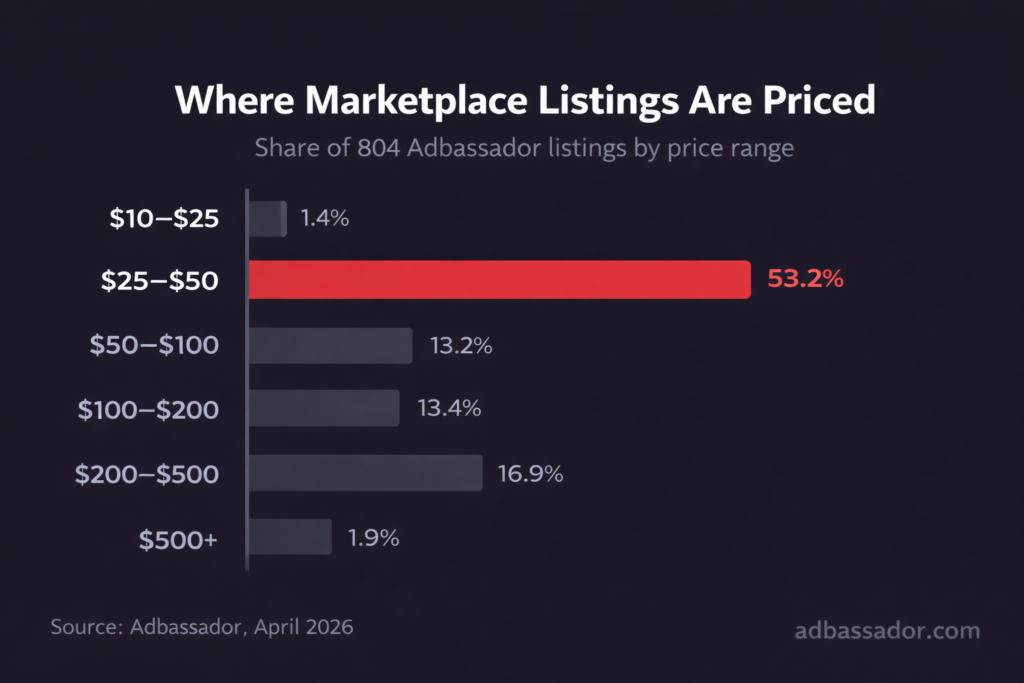
More than half of marketplace listings are priced between $25 and $50. These are not low-quality sites. They are real niche blogs with actual traffic and editorial standards, making them the main choice for most link building campaigns.
The premium tier ($200+) represents about 18.8% of listings. These are typically DR 50+ domains with verified traffic, competitive niches, and sites that would take weeks of outreach to reach directly.
How Guest Posts Compare to Other Placement Types
Most buyers default to guest posts, but the market offers options:
Guest posts give you a new article built around your topic, your anchor text, and your context. Highest editorial control, highest content investment.
Link insertions (niche edits) place a link into an existing ranked article. No new content to write or approve. Typically faster turnaround and often cheaper per link: the $65 median vs. $30 reflects that you’re paying a premium for placement on a page that already has indexing history and traffic.
Press releases distribute a formatted announcement to news sites. Different use case; better for brand signals and coverage than for pure link equity.
Banner ads are display placements. Not a link building tool in the traditional sense, but useful for direct referral traffic from relevant audiences.
Agency vs. Marketplace: The Cost Gap
Siege Media estimates agencies charge around $361 per link in management fees alone, on top of placement costs. BuzzStream puts the all-in average at $1,459. For that same budget on a marketplace:
| Budget | Agency ($1,459 avg) | Marketplace (guest post median $30) |
| $500 | ~0.3 links | ~16 links |
| $1,000 | ~0.7 links | ~33 links |
| $5,000 | ~3.4 links | ~166 links |
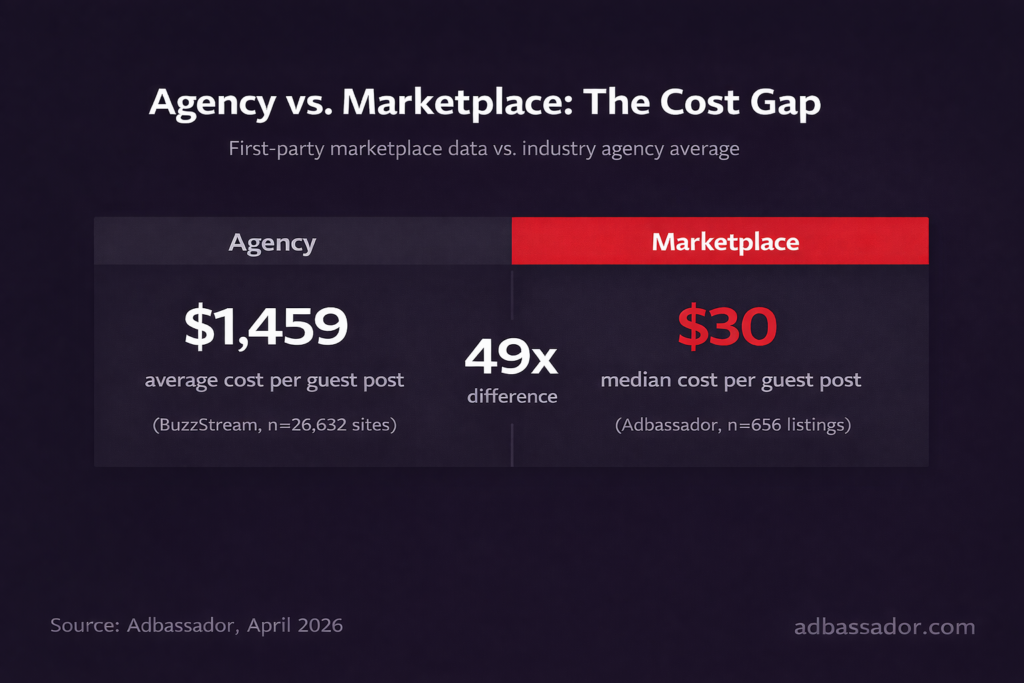
The difference is not because agencies are doing anything wrong. Outreach, relationship management, and account service all add to the cost. Marketplaces skip these services and focus on self-serve options.
3. The Publisher Landscape: What’s Actually Available
Not all guest post inventory is equal. BuzzStream analyzed 26,632 sites and found that less than 5% meet high-quality thresholds (DR 71+ and 50,000+ monthly organic traffic). The rest — the 95% — range from genuinely useful mid-tier sites to worthless domains that sell links regardless of relevance or quality.
This is the core quality problem in the guest posting market. There are more sites willing to accept paid placements than there are sites worth placing on.
How Marketplace Inventory Breaks Down by Placement Type
Based on 804 active listings on Adbassador:
| Placement Type | Listings | Share |
| Guest Posts | 656 | 81.6% |
| Link Insertions | 88 | 10.9% |
| Press Releases | 49 | 6.1% |
| Banner Ads | 19 | 2.4% |
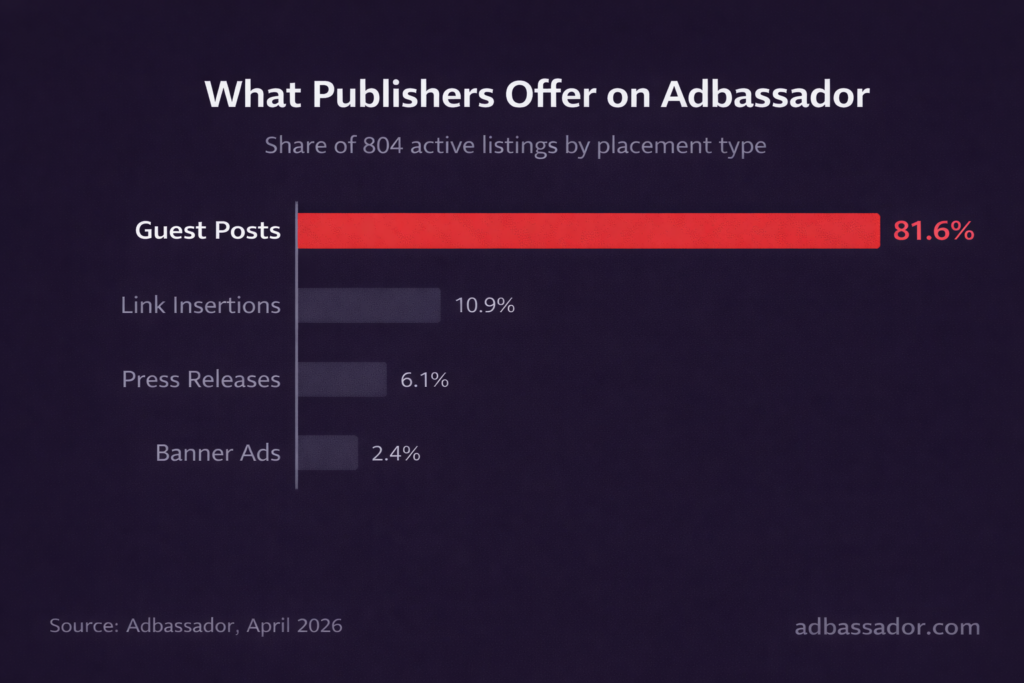
Guest posts are the most common because buyers prefer them and publishers are comfortable offering them. With a guest post, the publisher gets a new article, has full editorial control, and can approve the content. Link insertions need more trust since you are editing an existing article, and press releases require a different relationship with the site.
What Vetting Actually Looks Like
The supply side of the guest posting market has a serious quality problem. BuzzStream’s analysis of 26,632 sites found over 95% fall below the DR 71 plus 50,000 monthly organic traffic threshold. In our own review of publisher applications on Adbassador, common disqualifiers include inflated DA from link schemes, strong domain metrics paired with minimal organic traffic, and willingness to accept placements from any industry regardless of relevance: categories like gambling, payday loans, and adult content that then sit alongside your link on the same outbound profile.
Reputable marketplaces screen for verified traffic (not just domain metrics), real editorial content, and clean outbound link profiles. They also set niche restrictions and replace links if they disappear after placement. Unvetted platforms generally do none of these things.
In practice, DR and DA are just signals, not guarantees. A site with DR 45 but no organic traffic is less valuable than a DR 25 site with 5,000 monthly visitors in your niche.
4. Do Backlinks Still Work?
The short answer is yes, backlinks still work in a meaningful way.
Backlinko’s analysis of 11.8 million Google search results found that the #1 ranking position has 3.8x more backlinks than results in positions 2 through 10. Ahrefs’ own analysis of 1 million SERPs found the same figure. The correlation between referring domains and rankings remains one of the strongest documented signals in SEO research.
More recently, Google’s internal documents surfaced during the 2024 DOJ antitrust trial confirmed that links are still part of the core ranking signal framework – described internally as part of the “ABC signals” alongside anchors, body text, and clicks.
Google has also been increasingly aggressive about low-quality link schemes. The March 2024 core update, combined with the site reputation abuse policy introduced in late 2024, removed a significant portion of manipulative link inventory from search results. Google stated the Helpful Content Update and related changes reduced unhelpful content in search results by 40%.
This is good news for buyers who focus on quality link building. Each update removes low-quality competitors and makes quality placements even more valuable.
The Risk Question
Buying links of any kind technically violates Google’s spam policies. That’s been true for years and the policy hasn’t changed. What has changed is the enforcement precision.
Google’s spam system targets patterns: sudden link spikes, exact-match anchor chains, links from sites with no organic traffic, obvious PBN footprints. A handful of well-placed links on real sites with varied anchors and topical relevance rarely triggers action. The sites that get penalized are typically those building 200 links a month on a 5-year-old domain with 3 pages of content.
If you pace your link building, use different anchor text, and buy from vetted sources, you lower your risk. Chasing high volume on cheap sites increases your risk.
5. The Outreach Problem (and the Marketplace Solution)
Manual outreach is another way to build guest post links, but it is very inefficient.
Backlinko’s study of 12 million outreach emails found an 8.5% response rate: meaning over 9 in 10 pitches go unanswered. Authority Hacker’s data, drawn from 600,000+ emails across 78 campaigns, puts the effort at approximately 146 emails per earned link.
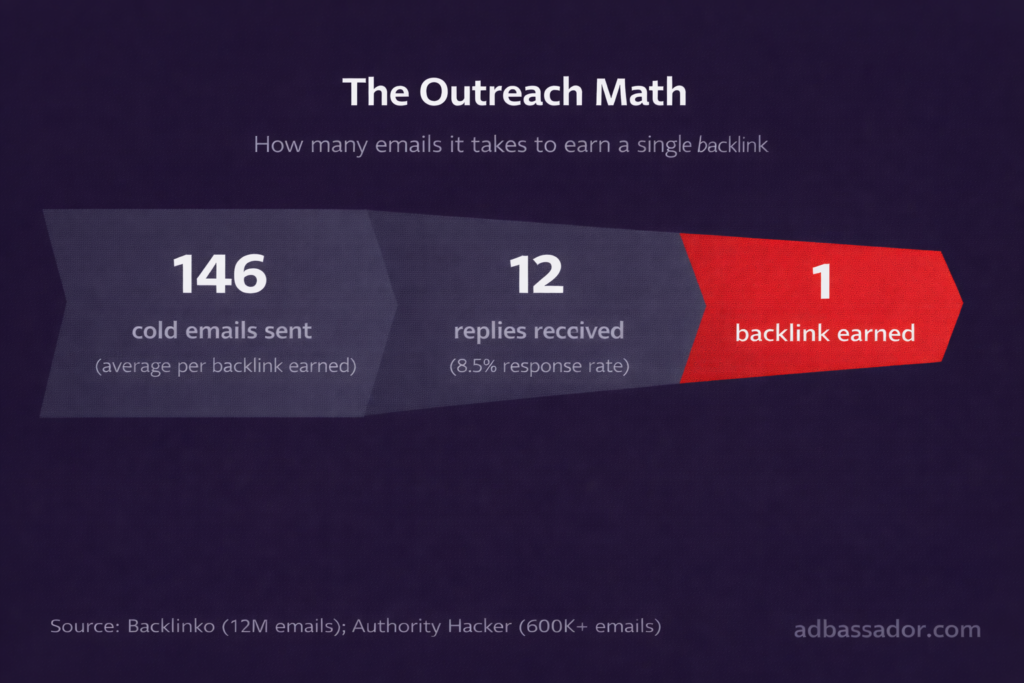
At $100 to $150 per hour in agency labor, that’s roughly $500 to $1,500 in staffing cost before any placement fee. Even doing it in-house, the time cost is real.
Marketplaces remove this extra effort. You can browse publishers with verified metrics, filter by niche and price, place an order, and get your link live. Most marketplace placements go live in a few days to a couple of weeks, while manual outreach often takes 2 to 4 weeks just to confirm one placement.
The tradeoff is that links earned through outreach on sites that do not accept paid placements may seem more credible. For top-tier placements like major publications or authority news sites, outreach or digital PR is usually required. For most mid-tier placements, marketplaces are faster, cheaper, and offer consistent quality.
6. The AI Content Disruption
The flood of AI-generated content since 2023 has had a visible effect on the guest posting market. Google’s March 2024 update specifically targeted scaled content abuse – including the practice of publishing large volumes of AI-generated articles purely to host backlinks.
Publishers who did not improve their editorial standards have lost traffic, and some have left the market. For buyers, this means low-quality options are harder to find, while quality publishers now expect higher standards for submitted content.
For guest post buyers in 2026, the content you submit is more important than it was in 2022. If you submit AI-generated articles to publishers with real editorial standards, they will likely reject them. The marketplaces that have lasted through the AI content surge are those that check both publisher traffic and the quality of submitted content before passing it on.
7. Market Context: Where Guest Posting Sits
Guest posting is just one tactic within the larger digital marketing industry.
The global digital advertising market reached $715 billion in 2025, growing 8% year-over-year. Content marketing specifically — the category that includes guest posting, sponsored content, and native placements — is a $94 billion industry growing at roughly 10% annually.
Within content marketing, native advertising (the broader category that includes sponsored and editorial placements) accounts for 63% of all digital display ad spend. U.S. native display spending alone is projected at $148 billion in 2026.
Guest posting fills a specific role in this ecosystem. It is a form of native advertising that focuses on long-term SEO value rather than short-term traffic. While a banner ad brings clicks only while it is active, a guest post on a DR 40 site continues to pass link equity as long as it remains indexed.
8. What to Expect: Trends Going Into 2026
The trend toward higher quality will continue. Google’s enforcement has led to fewer but better publishers. Cheap bulk link schemes are now riskier, and mid-tier vetted placements are more valuable.
Prices for quality sites are not likely to drop. The number of sites with real editorial standards and organic traffic has not kept up with demand. The $30 to $50 range will likely remain steady, while premium DR 50+ sites may become even more expensive.
Link insertions, also known as niche edits, will become more popular. They are faster, often cost less per link, and are placed on pages that already rank. Buyers who want efficiency will use both link insertions and guest posts instead of relying on just one method.
AI content detection will improve as publishers invest in better tools. Even if content is not flagged by a detector, editors are getting better at spotting AI-generated writing. Buyers who submit useful, specific articles will keep getting placements, while those who send generic summaries will see more rejections.
9. Frequently Asked Questions
Is buying guest posts legal?
Yes. There’s nothing illegal about paying a publisher to host your content. What can violate Google’s spam policies — which are Google’s rules, not government laws — is buying links that pass PageRank without disclosure. That’s why the practical guidance for buyers focuses on placement quality, anchor text variation, and topical relevance rather than volume.
Will buying guest posts get my site penalized?
It depends entirely on what you buy and how you pace it. Google’s spam systems target patterns: sudden link spikes, exact-match anchor chains, links from sites with no organic traffic, PBN footprints. A handful of placements per month on real sites with varied anchors rarely triggers action. Building hundreds of links monthly on a young domain with cheap inventory is what draws enforcement.
What’s the difference between a guest post and a sponsored post?
Mostly terminology. A “sponsored post” typically implies the publisher discloses the commercial relationship (often with a “sponsored” tag or rel=”sponsored” link attribute). A “guest post” historically implied contributed editorial content. In practice, most paid guest posts on marketplaces don’t carry the sponsored tag – which is a separate discussion about disclosure, not about whether the placement is legitimate.
How is a guest post marketplace different from a PBN?
A PBN (private blog network) is a network of sites owned by the same operator, built specifically to host links back to money sites. The sites usually have no real traffic, no real audience, and no editorial standards. A marketplace is a directory of independent publishers with their own traffic and audiences … the marketplace just brokers the transaction. Quality varies, which is why vetting matters.
What makes a “quality” guest post site?
Real organic traffic (not just domain metrics), editorial review of submitted content, a clean outbound link profile, topical relevance to your industry, and indexing in Google. A DR 50 site with 5 monthly visitors is worth less than a DR 25 site with 5,000 monthly visitors in your niche.
Nofollow vs dofollow: which matters more?
Dofollow links pass link equity and directly influence rankings. Nofollow links (including rel=”sponsored” and rel=”ugc”) officially don’t pass equity, though Google has said it treats them as “hints” and may pass some signal. For SEO purposes, dofollow placements are more valuable. For brand exposure, referral traffic, and natural link profile diversity, nofollow placements still have value.
What’s the difference between a guest post and a link insertion (niche edit)?
A guest post is a new article you write (or commission) that gets published on the host site with your link included. A link insertion places your link into an existing published article on the site. Link insertions are typically faster and often cheaper per link, and the placement goes on a page that may already have ranking history and traffic. The tradeoff is less control over context.
How fast do guest post links affect rankings?
Google typically discovers the link within days of publication if the host site has regular crawl activity. Ranking impact usually takes longer: anywhere from two weeks to three months depending on site authority, keyword competition, and how many other signals are changing. Links to pages with weak existing signals often show faster movement than links to pages already competing at the top of a SERP.
How many guest posts do I need?
There’s no universal answer. For a new site, a realistic starting benchmark is 8 to 15 links over the first quarter to establish topical relevance. Established sites targeting competitive keywords typically look at what the existing top-ranking pages have and aim for something in that neighborhood. Chasing an absolute link count is less useful than chasing links from the right sites for your specific keyword set.
Are guest posts still worth it in 2026?
The research says yes. Backlinko’s analysis of 11.8 million SERPs found the top-ranking page has 3.8x more backlinks than positions 2-10. Google’s internal ranking documents surfaced in the 2024 DOJ trial confirm links remain a core ranking signal. The caveat is that quality now matters much more than it did five years ago: a single placement on a vetted site with real traffic is worth more than ten placements on low-quality inventory.
Methodology
Marketplace data: All pricing, listing, and placement type data is drawn from live publisher listings on Adbassador, a vetted guest post marketplace. The dataset reflects 804 published listings as of April 15, 2026 (656 guest posts, 88 link insertions, 49 press releases, 19 banner ads). Pricing figures are based on published list prices for each placement type. Median and average values are computed across all listings with a non-zero regular price.
Third-party research cited in this report:
- Authority Hacker / DemandSage link building survey (755 link builders): https://www.demandsage.com/link-building-statistics/
- Backlinko outreach study (12 million emails): https://backlinko.com/email-outreach-study
- Backlinko SERP analysis (11.8 million results): https://backlinko.com/search-engine-ranking
- Ahrefs SERP study (1 million search results): https://ahrefs.com/blog/search-traffic-study/
- BuzzStream guest post cost analysis (26,632 sites): https://www.buzzstream.com/blog/guest-post-costs/
- Siege Media link building cost study: https://www.siegemedia.com/seo/link-building-cost
- Editorial.Link SEO survey (518 experts): https://editorial.link/link-building-statistics/
- MAGNA / IPG Mediabrands, Global Ad Forecast (December 2024 update). Publicly summarised via the MAGNA press page: https://magnaglobal.com/category/press-releases/ – full report is subscription-only.
- Content Marketing Institute & MarketingProfs, B2B Content Marketing Benchmarks, Budgets, and Trends: Outlook for 2025 (free report, registration gated): https://contentmarketinginstitute.com/research/annual-b2b-content-marketing-study
- eMarketer / Insider Intelligence, US Native Digital Display Ad Spending Forecast 2025 (paywalled; summary figures available via their public press releases at): https://www.emarketer.com/newsroom/
- Google Search Central spam policies: https://developers.google.com/search/docs/essentials/spam-policies
- Google DOJ antitrust trial coverage (Search Engine Journal): https://searchengineland.com/how-google-search-ranking-works-445141
Disclosure: This report was produced by Adbassador, a guest post marketplace. First-party data reflects our own platform. We’ve cited third-party sources where available to provide independent context.
If you want to estimate the ROI of a guest posting campaign before spending money, try our free Guest Post ROI Calculator. Enter your keyword volume, current position, and DR targets to see projected traffic increases, new ranking positions, and payback period.
Browse the Adbassador marketplace to see the 800+ vetted publishers referenced in this report.
I’ve been dabbling in guest posting since 2012, and it’s true that the whole “guest posting is dead” thing has been tossed around for YEARS now! Thank you for this extensive report.
Author here! If you want to cite any of the stats in this report, there’s a citation block near the top with APA format and a canonical URL. I’m also here to answer questions about the data or methodology 😊
This is a great reality check for anyone currently struggling with the inefficiencies of cold outreach. The quality vs. volume trade-off in guest posting is real, and having a vetted marketplace to navigate that is a massive time-saver. Thanks for the transparency!