Highly-vetted marketplace connecting publishers and advertisers

Niche Edits Marketplace: How to Buy Link Insertions Safely in 2026

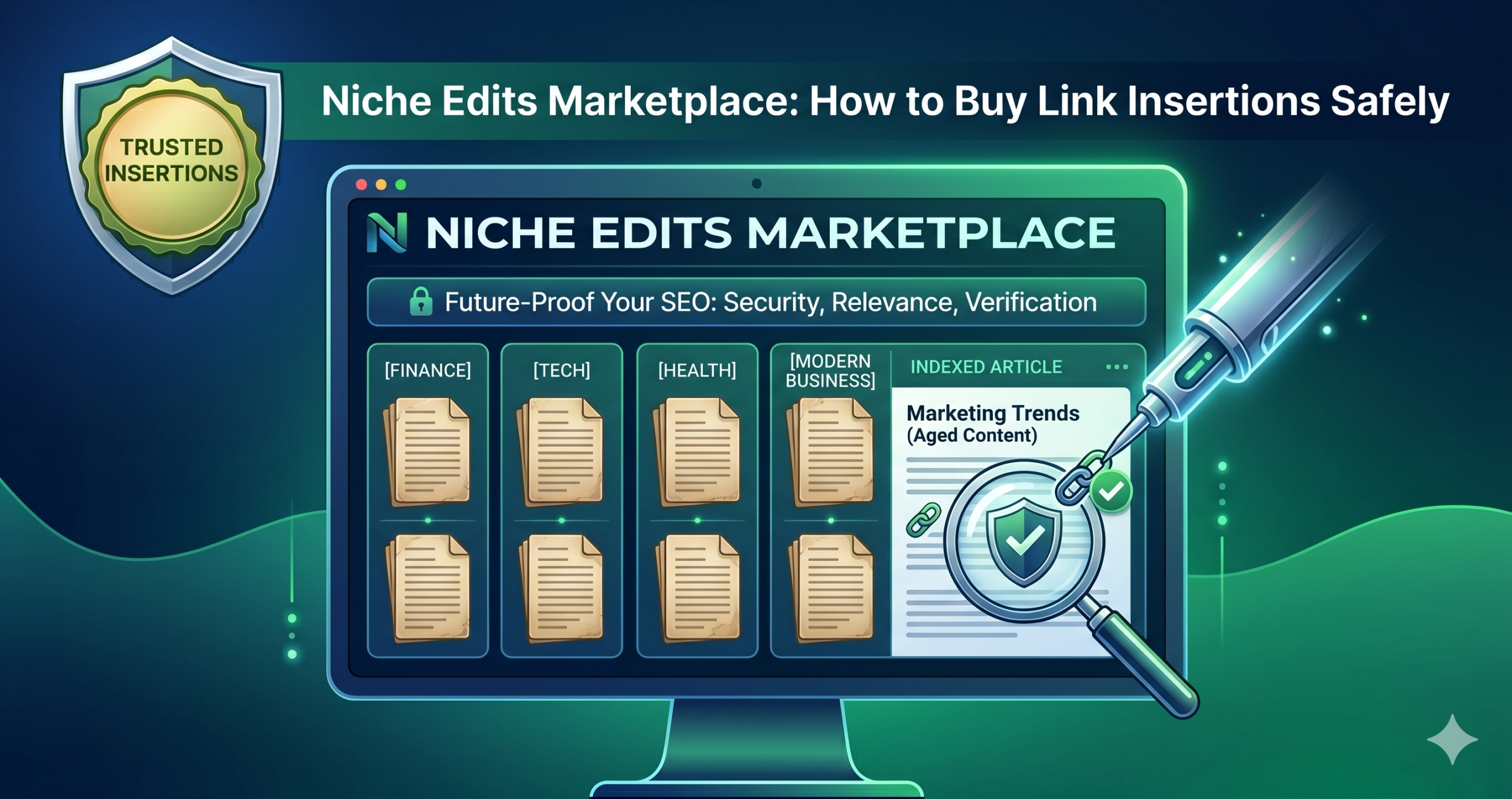
Link insertions are an efficient method for building backlinks. No outreach campaigns needed, no waiting weeks for a response, no writing long articles. You find a relevant page, place a link, and the process often wraps up within 48 hours.
But the niche edits market is inconsistent in quality. For every legitimate placement on a real editorial site, many providers offer links on pages that are hidden from search results, sitting inside private blog networks, or so crowded with outgoing links that yours gets buried in a long list. Knowing the difference ensures your link is actually worth paying for.
What Niche Edits Actually Are
A niche edit is a backlink placed inside an article that is already published. Instead of commissioning new content, the publisher finds a relevant sentence in an existing post and edits in a link to your site with agreed anchor text.
The reason these links work well for SEO is that the page already exists and is already indexed. Search engines have had time to evaluate it. A link from a page that has been on a real site for two years and accumulated its own organic traffic carries different weight than one from an article published yesterday.
They tend to be cheaper and faster than guest posts for the same reason. There is no content to write, no editorial review of a new draft. The publisher makes a small edit and the link is live.
Are Niche Edits Against Google’s Guidelines?
Buyers often ask about this and most providers dodge the question. The honest answer is that buying links of any kind technically violates Google’s link scheme policies, guest posts included, and niche edits too.
But there is a difference between rules and enforcement. When Google penalizes sites, they look for patterns: a sudden spike in link volume, repetitive anchor text, links from irrelevant or clearly low-quality sites. A handful of well-placed links on real editorial sites with varied anchors is a different situation. The practical risk there is low.
Sites that face higher risk are those acquiring 200 links in a month, using the same exact-match anchor text across every placement, or buying from sources that exist purely to sell links. Pace your progress, vary your text, buy from vetted sources, and the risk stays minimal.
The Risk Spectrum
The quality of niche edits varies a lot, and the price usually reflects it.
At the low end, bulk services insert links into networks the provider controls. The sites look real on the surface but have no genuine traffic and exist only to sell links. These are effectively PBN links with a different label. Prices run $5 to $20.
In the middle tier are outreach-based services where a provider contacts real site owners. Quality here is inconsistent. Some are legitimate operations, others are running small networks that look like outreach targets from the outside.
At the high end are vetted marketplaces where each publisher goes through a review process. Traffic is verified, links go into contextually relevant sections, and you see the data before you pay. These are the placements worth paying for, and prices run $25 to $500+ depending on domain authority.
What Niche Edits Cost in 2026
Costs scale with domain authority. Based on current market rates:
| Domain Rating | Typical Price Range | What You’re Getting |
|---|---|---|
| DR 10–19 | $20–$60 | Entry-level, good for new sites building initial authority |
| DR 20–29 | $60–$120 | Mid-tier, solid for most campaigns |
| DR 30–39 | $120–$200 | Good authority, meaningful trust signal |
| DR 40–49 | $200–$350 | High authority, significant ranking impact |
| DR 50–59 | $350–$500 | Very high authority, competitive niches |
| DR 60+ | $500+ | Premium, reserved for competitive head terms |
For broader pricing benchmarks across guest posts, link insertions, and press releases, the State of Guest Posting 2026 report covers current rates across 800+ publisher listings.
For campaigns targeting low-to-medium competition keywords, DR 20–40 hits the sweet spot between cost and impact. A DR 70 link is not necessary to rank for a keyword with a difficulty score of 25.
Guest posts at equivalent authority levels typically cost 30–60% more because of the writing requirement. If budget is tight, link insertions give you more total placements for the same spend.
Not sure how many links you need or what ROI to expect before committing budget? Use our free Guest Post ROI Calculator. Input your keyword’s monthly search volume, current position, and DR targets to see estimated traffic lift, new ranking position, and payback period before you spend anything.
Niche Edits vs. Guest Posts: Which Should You Use?
Both are valid methods. The choice depends on the goal.
Guest posts are better when:
- Topical relevance and context matter (the article is built around your subject)
- You want brand visibility alongside the backlink
- You’re targeting competitive head terms that need strong topical signals
- Timeline allows for a longer turnaround
Niche edits are better when:
- You need links quickly (24–48 hours vs. weeks)
- Budget is tighter and you want to maximize volume
- You’re pushing pages already in the top 30–50 over the ranking threshold
- You want a link from a page with existing traffic and indexing history
Effective campaigns use both. Guest posts build topical relevance. Link insertions build authority volume efficiently. Using only one means leaving efficiency on the table.
What to Check Before You Buy
Whether using a marketplace or going direct, verify these five things before placing an order.
Real organic traffic. Pull the domain into Ahrefs or Semrush and check the traffic estimate. Under 500 monthly visits is a yellow flag for any site charging more than $30. Also check where the traffic comes from. A site getting 10,000 visits but 95% from a single unrelated country is running an inflation scheme.
The page is indexed. Search the specific URL in Google. If it doesn’t show up, the link is worthless. Some sites index fine overall but have certain categories blocked from crawl. Verify the individual page, not just the domain.
Outbound link context. Look at what else the page links to. If it’s pointing to gambling sites, CBD shops, or crypto projects, that neighborhood follows your link. A lower-authority site with clean content is a better placement than a higher-authority one surrounded by spam.
The edit is contextual. A good insertion fits naturally into the text. A poor one adds a sentence at the end like an afterthought. Ask to see the specific location of the link before you pay.
The site isn’t over-monetized. Sites that sell guest posts, link insertions, display ads, and affiliate offers all at once aren’t focused on editorial quality. Google has gotten good at identifying these.
How Reputable Marketplaces Vet Their Publishers
The best platforms don’t just list any site that applies. A proper vetting process covers:
- Traffic verification using third-party tools like Ahrefs, not self-reported numbers
- Manual editorial review: someone reads recent posts to evaluate content quality
- Outbound link audits to flag sites linking to spammy industries
- Ongoing monitoring so sites that drop in traffic get removed from the network
- Link permanence guarantees: replacement if a link disappears within 12 months
When evaluating a marketplace, ask how they handle each of these. Vague answers usually mean there isn’t a real process.
Niche Restrictions: What Marketplaces Accept (and Don’t)
Not every topic can get placements on quality sites. Publishers have standards, and most reputable marketplaces enforce restrictions around certain industries.
Generally accepted: SaaS, technology, marketing, e-commerce, finance, health and wellness, business, education, travel, lifestyle
Case-by-case (fewer publishers, higher prices): CBD, cannabis, supplements, sports betting, cryptocurrency, gambling, legal services
Typically rejected: Adult content, pharmaceuticals, weapons, counterfeit goods, predatory lending
If your site is in a restricted niche, expect a smaller publisher pool and higher prices for the ones that do accept. Some specialized marketplaces focus on specific niches like health or finance, which can open more options.
Marketplace Comparison: Top Platforms in 2026
| Platform | Pricing (approx.) | Publisher Count | Vetting | Best For |
|---|---|---|---|---|
| Adbassador | $5–$500+ | 800+ | Manual vetting, verified traffic | Transparent metrics, fast turnaround (24–48hr median) |
| SerpZilla | $15–$400+ | 30,000+ | Automated + manual | Volume, wide niche coverage |
| Repute Post | $23–$300+ | 5,000+ | Manual review | Mid-market quality |
| Loganix | $100–$500+ | Curated | High-bar manual vetting | Premium quality, conservative buyers |
| FatJoe | $83–$600+ | Curated | Manual | Agencies, white-label |
Key questions before ordering from any platform: How do you verify traffic? What’s your link replacement policy? Can I see the specific page before I pay?
Anchor Text Strategy for Link Insertions
Over-optimizing anchor text is a common mistake. Because the placement is transactional and the publisher accommodates your request, it’s tempting to use exact-match keywords every time. That’s a mistake.
A natural backlink profile has a mix of anchor types. For a campaign of 10 links, a reasonable distribution:
- Branded (“Adbassador”, “YourBrand”): 50–60%
- Naked URL (“yourdomain.com/page/”): 15–20%
- Partial match (“guest post marketplace guide”): 10–15%
- Generic (“this resource”, “here”, “read more”): 10–15%
- Exact match (“best guest post marketplaces”): 5–10% at most
If 10 links all use the same keyword anchor, that pattern is easy to detect algorithmically. Vary it. Niche edit anchors don’t need to follow different rules than guest post anchors, just apply the same distribution across your full link profile.
What to Expect: A Realistic Timeline
The “under 48 hours” claim refers to how fast a link can be physically placed. Ranking impact takes longer.
- Days 1–3: Order placed, marketplace identifies publishers with relevant pages
- Days 4–14: Link placed on publisher’s site, page gets next crawl by Googlebot
- Weeks 2–4: Link appears in Google Search Console Links report
- Weeks 4–8: Potential position movement for keywords already in the top 30–50
- Weeks 8–12: Measurable traffic impact for competitive keywords, assuming solid on-page SEO
Sites most likely to see faster results are those with pages already ranking somewhere in positions 20–50. The links push those pages over the threshold rather than starting from scratch. If the site has no ranking history, content and on-page work should come before link building.
Five Mistakes That Make Niche Edits Fail
1. Buying from the same network repeatedly. If a provider’s sites share hosting footprints or are interlinked, Google may treat them as a single source. Vary your sources across different providers.
2. Expecting results before the timeline plays out. A link placed today won’t help rankings tomorrow. Some buyers give up before the 8–12 week window closes.
3. Using the same anchor text across every placement. Exact-match anchor patterns are one of the clearest signals of manipulative link building.
4. Not verifying the link stayed live. Follow up 30 days after each placement. Site redesigns, content pruning, and editorial changes happen more than you’d expect.
5. Building links to a page that isn’t ready to rank. A link to a thin, poorly optimized page with no internal links is wasted. Make sure target pages have solid on-page SEO before pointing external links at them.
The Short Version
Niche edits work. They’re faster and cheaper than guest posts for equivalent authority levels, and links from aged, indexed pages can pass value quickly when placed well. But the market has a quality problem, and the wrong placements won’t move rankings.
Buy from a vetted marketplace that shows verified traffic data, check that the specific page is indexed, look at the outbound link context, vary your anchor text, and give it 8 to 12 weeks before judging results. Do those things and you’ll avoid most of the problems that make people say link insertions don’t work.