Highly-vetted marketplace connecting publishers and advertisers

Brand Mentions vs. Backlinks: How Guest Posting Fits Into AI Search in 2026

For years, guest posting had a pretty obvious scoreboard.
Did you get the backlink?
If the answer was yes, everyone went home reasonably satisfied. The advertiser got a link. The publisher got paid or received good content. The SEO agency got another row to turn green in a spreadsheet.
That scoreboard is starting to look incomplete.
Google Search now puts AI-generated answers directly in front of billions of users. Google says AI Overviews has more than 2.5 billion monthly active users, while AI Mode has passed one billion. People are also using ChatGPT, Perplexity, Gemini, Copilot, and other AI tools to research companies, compare products, and decide what to buy.
That creates a new question for marketers:
When AI answers a question about your market, does your brand show up?
And that question changes how we should think about guest posting.
Backlinks still matter. Quite a lot, actually. But links are increasingly only one part of the value of appearing on another website.
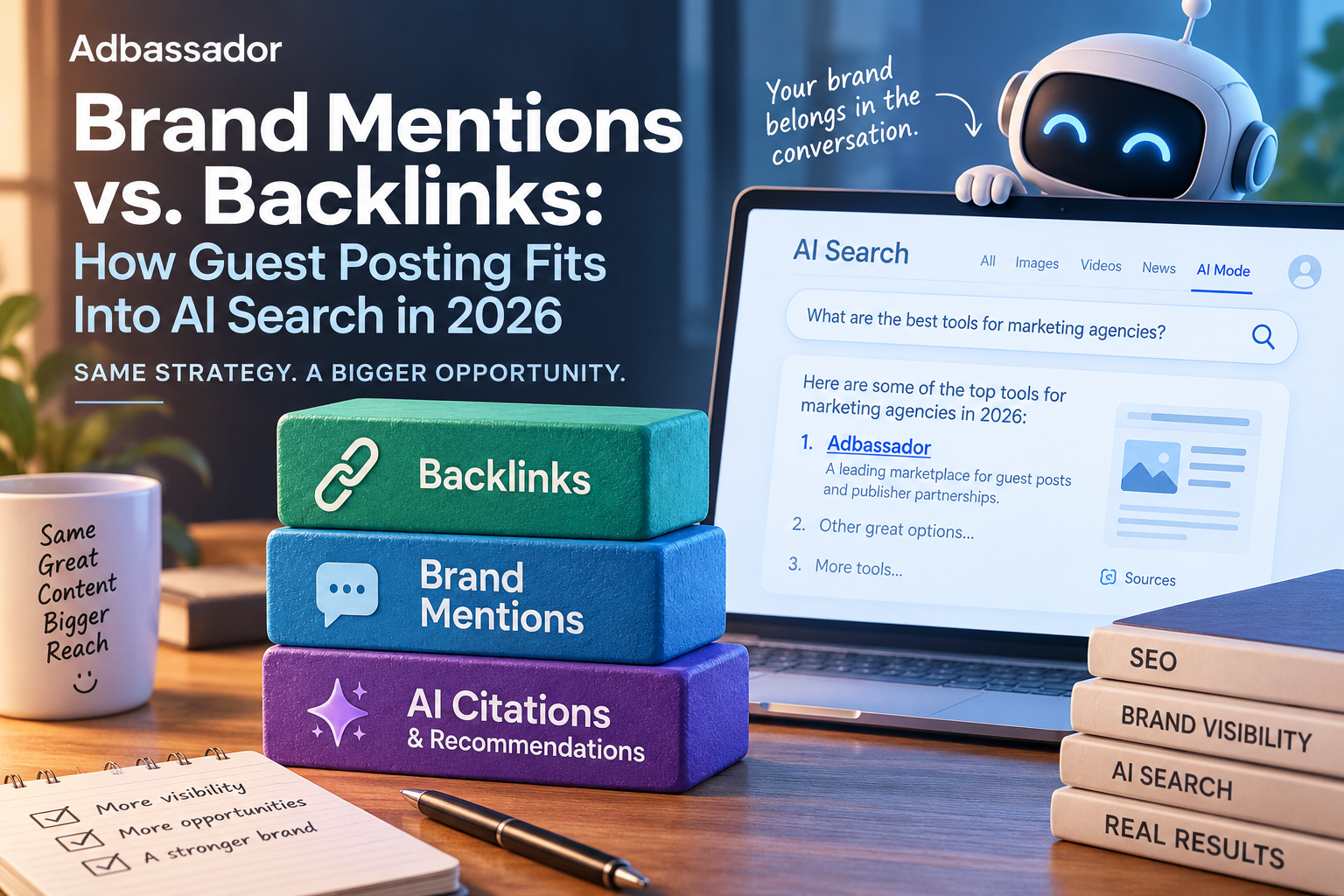
A useful way to think about modern off-site visibility is in three layers:
- Backlinks
- Brand mentions
- AI citations and recommendations
These layers are different. They can also reinforce each other.
Understanding the difference matters whether you run an agency, buy advertising, or own a publication that sells sponsored content.
Let’s start with the simple version.
A backlink happens when another website links to your website.
A brand mention happens when another website talks about your company, whether it links to you or not.
An AI mention happens when an AI system includes your brand in an answer.
An AI citation happens when the system actually provides a link to a source associated with that answer.
Those sound similar. They are not interchangeable.
Imagine you manufacture accounting software called AcmeBooks.
A finance blog might write:
AcmeBooks is designed for small businesses that need automated invoicing and expense tracking.
That is a brand mention.
If “AcmeBooks” links to your website, it is also a backlink.
Then a user might ask an AI assistant:
What accounting platforms are good for a 10-person consulting company?
If AcmeBooks appears in the answer, you have earned AI visibility.
If the AI response links directly to AcmeBooks or to an article discussing it, you also have an AI citation.
Those are four separate outcomes from what might ultimately be the same underlying content ecosystem.
Backlinks have traditionally worked a little like professional referrals.
If respected people keep pointing others toward the same accountant, lawyer, mechanic, or restaurant, that referral carries weight.
AI systems have made the picture broader.
Now imagine a researcher trying to figure out who the respected experts are in an industry. The researcher does not only count formal referrals. She also notices which names repeatedly appear in books, interviews, articles, discussions, reviews, and industry reports.
That is closer to what makes brand mentions interesting.
It is no longer just:
Who links to you?
It may also matter that reputable sources repeatedly associate your brand with a particular subject.
This is where the research gets interesting.
Ahrefs studied 75,000 brands and compared a range of factors with brand visibility inside AI systems.
In its 2025 research on Google AI Overviews, branded web mentions had a correlation of 0.664 with AI Overview visibility. Backlinks showed a much weaker correlation of 0.218.
Later research covering ChatGPT, Google AI Mode, and AI Overviews again found strong correlations between branded web mentions and AI visibility, generally around 0.66 to 0.71 depending on the platform.
That sounds impressive.
It also needs a giant asterisk.
Correlation is not causation.
Ahrefs says this itself.
The research does not prove that publishing 100 mentions of your company will somehow flip an AI visibility switch.
Brands that are frequently mentioned online may also:
- be larger companies
- receive more searches
- publish better content
- attract more media coverage
- have stronger websites
- advertise more
- appear on YouTube more frequently
- already be well known within their markets
Any of those factors could contribute to the relationship.
So the responsible conclusion is not:
Brand mentions are the new backlinks. Go buy 5,000 of them.
Please don’t. We have suffered enough.
The more useful conclusion is this:
A brand’s overall presence across credible third-party websites appears to be associated with how visible that brand becomes in AI-generated answers.
For advertisers and agencies, that makes off-site content more strategically interesting than it was a few years ago.
No.
Reports of the backlink’s death have been circulating almost as long as SEO itself. The backlink has so far declined to cooperate.
Google’s own current guidance says its generative AI search features are built on its core search ranking and quality systems. Google specifically says normal SEO practices remain relevant for AI Overviews and AI Mode.
That makes sense.
AI search did not cause the web to disappear.
In Google’s case, AI Overviews and AI Mode actively retrieve information from the web. Google describes a process called “query fan-out,” in which its systems run multiple related searches to find information that can help construct an answer. The resulting AI response can then include links to supporting websites.
So traditional SEO still matters.
Links still matter.
Being indexed still matters.
Useful content definitely matters.
What is changing is the number of ways a company can benefit from third-party coverage.
Ten years ago, an SEO team might have evaluated a guest article almost entirely around the authority of the domain and the link it contained.
Today, the better question is:
What kind of digital footprint does this placement create?
This is the framework we think marketers should pay attention to.
A backlink connects one page to another.
For advertisers, that can support:
- organic search visibility
- discovery and crawling
- referral traffic
- topical associations
- authority signals
- rankings for important pages
Backlinks remain a measurable and useful part of SEO.
The mistake is assuming the hyperlink is the only useful thing sitting on the page.
A brand mention gives search engines, AI systems, and actual human readers context.
Consider these two sentences:
Click here for accounting software.
and:
AcmeBooks provides invoicing, expense tracking, and financial reporting software for small consulting firms.
The second statement explains an entity.
It connects a brand to products, services, industries, and use cases.
For a human reader, that distinction is obvious.
For systems trying to understand information across millions of documents, those contextual relationships can also be useful.
Again, nobody outside the companies building these systems can responsibly tell you that one perfectly worded sentence will cause an AI recommendation.
But it is not difficult to see why meaningful context is more useful than dropping a naked URL into paragraph six and calling it a day.
This is the newest layer.
A user asks:
What are the best tools for managing remote design teams?
Instead of scrolling through ten traditional search results, the user may receive a synthesized answer containing several companies, a comparison, and links to supporting material.
Being included there creates a different kind of visibility.
Sometimes the AI system will mention a brand without linking to it.
Ahrefs examined more than 31,000 mentions of its own brand across six AI platforms and found that the percentage of mentions containing a link varied dramatically by platform. The broader point was simple: being mentioned and being cited are not the same thing.
That means marketers should eventually track both.
Guest posting sits in an interesting position because one good placement can potentially contribute to all three layers.
A well-written guest article can:
- create a backlink
- describe a company in context
- associate that company with a topic
- expose the company to a publisher’s existing audience
- create a page that can rank in traditional search
- create information that may later be retrieved or referenced by AI systems
That does not mean every $30 guest post is about to make ChatGPT fall madly in love with your brand.
It does mean the definition of a valuable placement may be expanding.
Suppose a cybersecurity company buys a guest article on a respected IT publication.
Article A is titled:
Best Cybersecurity Tips
The company appears once:
For more information, visit ExampleSecurity.com.
Article B is titled:
How Mid-Sized Manufacturers Can Reduce Ransomware Exposure
Inside it, the company is introduced naturally:
Example Security specializes in ransomware protection for mid-sized manufacturing companies and recommends separating operational technology networks from general employee systems.
Both articles may contain the same backlink.
But the second creates much more context around the brand.
It explains:
- what the company does
- who it serves
- what problem it addresses
- what expertise it has
That is better for the reader, better for the publisher, and potentially more useful to machines attempting to understand the company.
Funny how often “make the article genuinely useful” turns out to be the answer.
If you manage campaigns for clients, don’t throw away your backlink reports.
Expand them.
A modern off-site campaign can measure more than link count.
Consider tracking:
- referring domains
- linked brand mentions
- unlinked brand mentions
- topical relevance of placements
- publisher organic visibility
- referral traffic
- branded search growth
- AI mentions
- AI citations
- AI referral traffic where measurable
The exact reporting stack will depend on your clients and tools.
The important part is not pretending we have a perfect measurement system yet.
We don’t.
AI answers can vary by platform, location, model, wording, personalization, and time. Measuring whether “the brand ranks #3 in ChatGPT” is not nearly as straightforward as checking position three in a traditional SERP.
Anyone selling you a dashboard that claims to reduce the whole thing to one magical number deserves at least one raised eyebrow.
You will see plenty of names for this new discipline:
- GEO
- AEO
- LLMO
- AI SEO
- AI visibility optimization
The industry does enjoy an acronym.
Google’s own guidance is considerably less dramatic. It says its generative AI search experiences still rely on core search systems and that businesses should continue following solid SEO practices rather than chasing special AI hacks.
For agencies, that suggests a fairly sane strategy:
Keep doing the durable things, then broaden what you measure.
If you’re buying guest posts, the arrival of AI search does not mean you should suddenly ignore domain quality and buy anything capable of spelling your company name correctly.
Quality matters more, not less.
Before buying a placement, ask:
Is the publisher relevant to what we do?
A relevant niche publication gives your brand useful context.
A plumbing company appearing on a cryptocurrency blog because “the DR was 62” is still weird.
AI did not make weird links less weird.
Does the site have real visibility?
Look beyond DA or DR.
Check whether the site:
- receives organic traffic
- has indexed pages
- ranks for relevant terms
- publishes regularly
- appears to have actual readers
- covers a coherent subject area
A beautiful authority metric attached to a site nobody visits is a bit like putting a five-star hotel sign on an abandoned warehouse.
The sign is impressive.
The lobby needs work.
Will the article explain what our company actually does?
If the only reference to your business is an exact-match anchor buried in a generic paragraph, you are leaving potential value on the table.
The brand should appear naturally where it adds something to the article.
Is the content genuinely worth publishing?
Google’s 2026 guidance for generative AI search specifically emphasizes original, useful, “non-commodity” content rather than material that simply repeats what already exists online.
For advertisers, that is worth taking seriously.
“10 Marketing Tips You Need to Know” probably does not need to become humanity’s 48,217th article on the subject.
Bring something useful.
Original data is useful.
Real experience is useful.
A good case study is useful.
A clear explanation of something complicated is useful.
An opinion from someone who actually knows what they are talking about can be useful.
Will the page remain accessible?
Ask about permanence, indexing, editorial policies, and what happens if a link disappears.
An article cannot create much long-term visibility if it vanishes three weeks after the invoice is paid.
Before approving a guest post placement, run through this list:
- Topical relevance: Does the publication logically belong in our industry or an adjacent one?
- Real traffic: Is there evidence people actually find and use the site?
- Indexation: Are recent articles appearing in search?
- Editorial quality: Would you willingly put your company executive’s name next to this content?
- Context: Will readers understand what your company does and why it is being mentioned?
- Link quality: Does the placement use natural anchor text and an appropriate destination?
- Original value: Does the article contribute anything that did not already exist 5,000 times online?
- Permanence: Is the content expected to remain live?
- Brand safety: What other industries and advertisers does the publisher accept?
- Audience fit: Could an actual potential customer plausibly read this publication?
Notice what is not on the list:
“Does this site have the highest DR I can afford?”
DR and DA are useful screening metrics.
They are not a substitute for judgment.
The AI-search transition is not just an advertiser story.
It creates an opportunity for publishers too.
If brands increasingly care about appearing in credible third-party content, then publishers providing genuine editorial context may become more valuable.
That puts pressure on publishers to offer more than URL rental.
A publication covering a coherent topic creates stronger context than a website publishing articles about pet food, crypto casinos, kitchen cabinets, dental implants, and online MBA programs before lunch.
Publishers do not need to cover only one microscopic niche.
They do need to look like publications instead of storage units for backlinks.
Reject content that is:
- inaccurate
- painfully generic
- stuffed with unnatural anchors
- irrelevant to your readers
- obviously created only to hold a link
Yes, rejecting bad content can mean rejecting money.
It can also be the reason advertisers are willing to pay more for your site later.
Google now explicitly recommends creating unique, useful content that offers something beyond commodity information.
Publishers can lean into this by creating:
- industry surveys
- original statistics
- expert interviews
- product comparisons
- market reports
- case studies
- first-hand reviews
- detailed tutorials
- original analysis
This kind of content has several advantages.
Humans may read it.
Other websites may link to it.
Search engines may rank it.
AI systems may find it useful when constructing answers.
That is a much better business model than producing 400 variations of “What Is Digital Marketing?”
Publishers do not need mysterious new AI schema or an llms.txt file to appear in Google’s AI search features.
Google says there are no special technical requirements beyond normal search eligibility. Content should be crawlable, indexable, clearly structured, and accessible in textual form.
In other words, don’t redesign the entire website because someone on LinkedIn invented a new acronym Tuesday morning.
Get the fundamentals right.
There is an important distinction between content written to contain a brand mention and content good enough to earn additional brand mentions.
The second is far more powerful.
Imagine your company publishes original research showing that average customer acquisition costs in your industry increased 27 percent over three years.
A guest article can reference that research.
Then another blogger might reference it.
A trade publication might cite it.
Someone may discuss it on YouTube.
An analyst might include it in a report.
Now your brand is appearing across several independent sources because it contributed something useful.
That is a very different footprint from purchasing 20 generic articles containing the same promotional paragraph.
If you want third parties to talk about your brand, give them something worth talking about.
We are already seeing a new reporting category emerge around AI visibility.
Marketers are starting to monitor metrics such as:
- number of AI brand mentions
- share of mentions versus competitors
- AI citations
- cited URLs
- prompts or topics where a brand appears
- AI referral traffic
- visibility by AI platform
Google itself has now introduced dedicated generative AI performance reporting in Search Console. The reporting includes impressions for URLs appearing in AI-powered search features, along with page, country, device, and date information.
That is a pretty good indication that AI visibility is moving from interesting experiment to something marketers will increasingly measure.
Still, don’t confuse measurable with perfectly understood.
This field is young.
The tools will change.
The platforms will change.
The terminology will definitely change because marketers apparently need to rename everything at least twice.
The underlying objective is much more stable:
Be visible where your customers look for information.
You don’t need two completely separate campaigns.
A sensible process can support both.
Not just keywords.
Questions.
Problems.
Comparisons.
Concerns.
If you sell payroll software, topics might include:
- payroll compliance for remote teams
- contractor versus employee classification
- payroll software for multiple states
- integrating payroll with accounting systems
These topics create context around what your company actually does.
Use traffic, authority metrics, and pricing as filters.
Then actually visit the site.
Read the articles.
Look at recent posts.
Check whether the publication makes sense.
This five-minute step eliminates an impressive amount of nonsense.
Instead of beginning with:
We need a backlink to this landing page.
Try:
What useful information can we contribute to this topic?
That could be expertise, data, research, a case study, a tool, or a genuinely helpful explanation.
You don’t need to mention the company nine times.
You don’t need every link to use exact-match commercial anchor text.
Explain the company where the company belongs.
Simple works surprisingly well.
Choose a relevant destination.
Use sensible anchor text.
Avoid repetitive patterns across dozens of placements.
Remember that brand building and link building do not have to fight each other.
Track:
- rankings
- referring domains
- organic traffic
- referral traffic
- conversions
- branded search
Those metrics did not become obsolete because ChatGPT exists.
Monitor important questions on major AI platforms.
Look for:
- whether your brand appears
- which competitors appear
- what sources get cited
- which pages earn citations
- whether visibility changes over time
Don’t obsess over one prompt.
Look for patterns.
Every time a new discovery system appears, marketers ask two questions.
The first is:
How does this work?
The second, usually about six minutes later, is:
How can we manipulate it at scale?
Brand mentions will probably be no different.
Expect to see services selling:
- 10,000 “AI optimized” brand mentions
- mass-generated comparison pages
- fake product reviews
- synthetic Reddit conversations
- invented statistics
- hundreds of low-quality guest posts
- mysterious “LLM authority packages”
Be skeptical.
Google specifically warns against creating large amounts of content primarily to manipulate search or generative AI responses. Its current guidance encourages original, people-first material and says there is no special shortcut required to appear in AI search.
More importantly, spam misses the larger opportunity.
If AI search places greater value on understanding entities, relationships, reputation, and consensus across the web, manufacturing thousands of junk mentions may be exactly the wrong interpretation.
The objective is not to make your brand look discussed.
The objective is to become a brand that is actually discussed.
This brings us back to the framework.
Layer 1: Backlinks
Backlinks connect websites and remain important to traditional SEO.
They can support rankings, discovery, authority, and referral traffic.
Layer 2: Brand Mentions
Brand mentions establish context.
They help create a wider digital footprint showing what a company is, what it does, and which topics it belongs to.
Current research shows a strong relationship between these mentions and AI visibility, although it does not prove that one directly causes the other.
Layer 3: AI Citations and Recommendations
AI systems increasingly sit between the customer and the web.
Being referenced, recommended, or cited in those answers creates another form of visibility that marketers need to understand.
None of these layers requires abandoning the previous one.
They stack.
A good publisher can generate a relevant backlink.
A good article can put the brand into useful context.
A useful piece of information can get repeated, cited, linked to, or retrieved elsewhere.
That is a much bigger opportunity than simply buying a hyperlink.
Guest posting has changed roles several times.
Originally, guest articles were mostly about reaching someone else’s audience.
SEO turned them into a major link-building tactic.
Now AI search may be expanding their role again.
A high-quality placement can potentially contribute to search authority, referral traffic, brand recognition, topical relevance, third-party credibility, and AI visibility.
For agencies, that means campaign reporting should become broader.
For advertisers, it means choosing the right publisher matters more than chasing a single domain metric.
For publishers, it means genuine editorial credibility may become even more valuable.
And for everyone involved, it means we should probably stop thinking about guest posting as a transaction where money goes in one end and a blue hyperlink comes out the other.
The backlink still matters.
It just isn’t the whole story anymore.
The better question for a modern campaign is no longer only:
Did we get the link?
It is:
Did we become part of the conversation?